
Description
Amunimuye — meaning ‘the one that does not allow the enemy to rest’ or ‘that which prevents evil from staying’
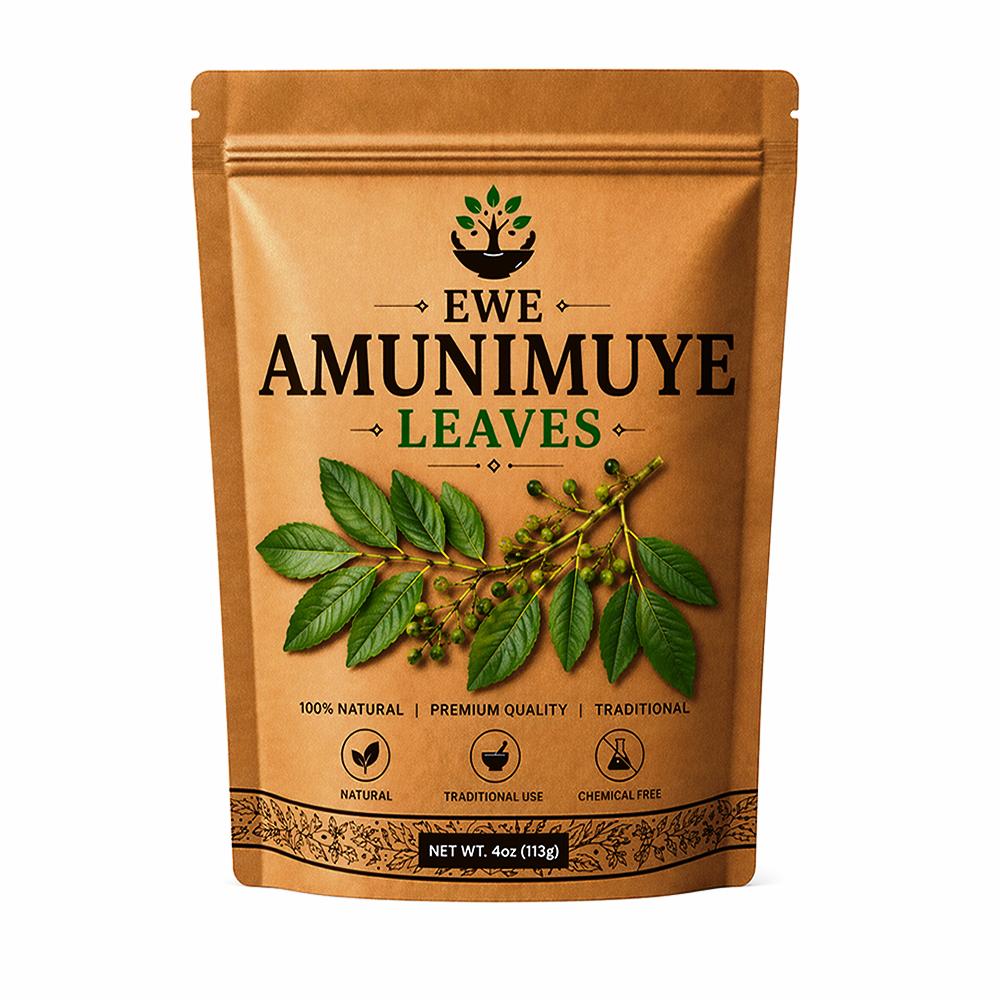
Ewe Amunimuye is one of the most revered and powerful leaves in Yoruba traditional herbal medicine. Derived from the Clausena anisata tree — a medium-sized aromatic shrub native to tropical Africa — the plant is recognisable by its pinnately compound leaves with small dark-green leaflets and clusters of tiny green berries on reddish stems, as shown on the packaging. The EWE brand packages it as 100% natural, premium quality, chemical-free dried leaves in a 4oz (113g) resealable kraft pouch. The name ‘Amunimuye’ reflects the plant’s reputation as a fierce spiritual protector that does not allow enemies or evil to dwell near a person. It has a strong aromatic anise-like scent due to its essential oil content. It is widely used across Yoruba land and by diaspora communities.
Use and Benefits
- SPIRITUAL PROTECTION: Considered one of the strongest protective herbs in Yoruba tradition — used in spiritual baths (iwosan) to ward off evil, enemies, witchcraft, and negative energies
- ANTI-MALARIA: Leaf decoctions are traditionally used to treat malaria, fever, and chills — supported by phytochemical studies showing anti-plasmodial activity
- ANTIMICROBIAL & ANTIFUNGAL: Active compounds (carbazole alkaloids) exhibit strong antibacterial and antifungal properties used against infections
- ANTI-INFLAMMATORY: Used to reduce pain and inflammation — applied in treatment of arthritis, rheumatism, and body swelling
- RESPIRATORY HEALTH: Inhaled as steam or drunk as tea to relieve cough, asthma, bronchitis, and chest congestion
- NEUROLOGICAL SUPPORT: Used in traditional treatment of epilepsy and convulsions — particularly in children
- DIGESTIVE HEALTH: Relieves stomach pains, intestinal worms, diarrhoea, and general digestive discomfort
- INSECT REPELLENT: The aromatic essential oils repel mosquitoes and other insects — used as a natural pest deterrent
- SKIN CONDITIONS: Applied topically in washes for eczema, rashes, fungal infections, and general skin cleansing
- RITUAL & IFA USE: Highly valued in Ifa divination, Orisha worship, and Yoruba traditional religious practices as a sacred cleansing herb


